



Why Mental Health Law Feels So Overwhelming for Families
Mental Health law is the group of federal and state rules that protects a person’s rights when mental health affects treatment, court cases, family decisions, school, housing, or access to health care.
For families, the basic rights are often clear even when the process is not:
- A mental health diagnosis alone does not remove a person’s legal rights or make them legally incompetent.
- Involuntary treatment or hospitalization must follow due-process protections under the 14th Amendment, including legal procedures designed to prevent unnecessary loss of liberty.
- Disability laws, including the Americans with Disabilities Act and Section 504 of the Rehabilitation Act, can protect people from discrimination and unnecessary segregation.
- Mental health needs can affect divorce, custody, guardianship, and criminal cases, but each area uses different legal standards and procedures.
The challenge is that a family may be dealing with health providers, schools, courts, insurers, and public agencies at the same time – often during a crisis. The law tries to balance safety, personal choice, privacy, treatment needs, and the rights of parents, children, and other family members.
I am Stacey Symoun, Attorney at WhitbeckBeglis, and I wrote this article to help potential clients understand the legal issues families often face when mental health concerns affect treatment decisions, commitment proceedings, guardianship questions, and related family-court concerns. My goal is to explain the legal framework in plain language so families know what questions to ask and when legal guidance may be needed.
Navigating Mental Health Law: Rights, Competence, and Involuntary Commitment
Understanding how Mental Health law treats personal freedom, decision-making capacity, and mandatory care is vital when helping a loved one. When a family member experiences severe distress, relatives often struggle to determine whether they have the legal standing to step in—or whether their loved one retains absolute decision-making autonomy.
Legal Competence and Civil Rights in Mental Health Law
In legal contexts, competence is not a clinical diagnosis; it is a legal determination. Having a diagnosed conditions such as depression, bipolar disorder, or schizophrenia does not automatically strip an individual of their constitutional liberties or legal capacity.
To learn more about the broader framework of these regulations, explore our detailed guide on Mental Health Law.
Legal competence refers to an individual’s capability to understand legal proceedings, execute binding legal contracts, manage financial assets, or make healthcare decisions. A court evaluates legal competence based on functional ability rather than a medical label alone:
- Contractual and Financial Capacity: A person is presumed competent to manage their assets and enter agreements unless a judge rules otherwise based on clear evidence of incapacity.
- Healthcare Decision-Making: Adults generally have the right to consent to or refuse medical treatment when they can understand the nature, risks, and benefits of the decision.
- Maryland Family Law and Custody: In Maryland custody matters, a mental health condition is not automatically disqualifying. The court focuses on the child’s best interests and on evidence of how a parent’s condition affects day-to-day parenting and the child’s welfare.
- Maryland Guardianship Options: When an adult may need help with personal or financial decisions, Maryland families can review the state judiciary’s guidance on alternatives to guardianship before pursuing a court-appointed guardian.
Balancing Due Process and Mandatory Treatment
When a person’s psychiatric condition causes an immediate danger to themselves or others, state laws permit involuntary commitment. However, because involuntary hospitalization deprives a person of bodily liberty, the U.S. Constitution imposes strict legal boundaries.
Under the Due Process Clause of the 14th Amendment, civil commitment statutes must maintain a direct, reasonable relationship between the reason for detention and the actual treatment provided. States cannot confine individuals indefinitely simply for exhibiting eccentric behavior or social non-conformity.
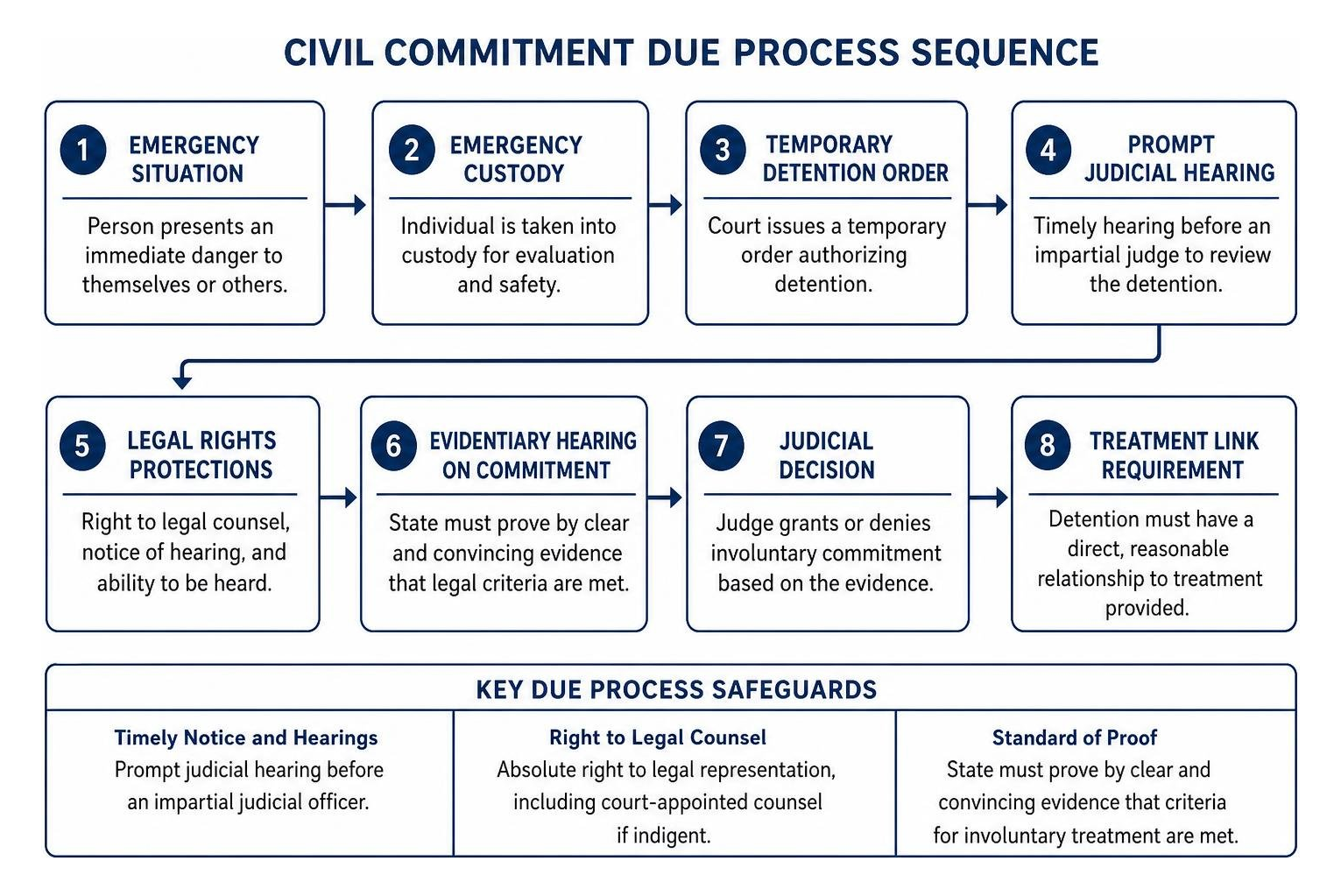
To protect civil liberties during crisis interventions, statutory safeguards require:
- Timely Notice and Judicial Hearings: Individuals subject to emergency custody or temporary detention orders must be granted a prompt judicial hearing before an impartial judicial officer.
- Right to Legal Counsel: Individuals facing involuntary commitment have an absolute right to legal representation, including court-appointed counsel if indigent.
- Standard of Proof: The state must prove by clear and convincing evidence that the individual meets the statutory criteria for involuntary treatment.
- Least Restrictive Alternative: Courts are legally mandated to consider outpatient treatment programs or community support services before ordering inpatient hospitalization.
For step-by-step guidance on how state procedures manage non-voluntary hospitalizations, review our overview of Commitment of Mentally Ill Individuals alongside Maryland Department of Health resources on involuntary admission hearings.
Mental Health Law in Criminal Justice and Crisis Response
The intersection of mental illness and the penal system presents significant legal hurdles for families. Rather than receiving clinical support, individuals experiencing severe behavioral health episodes are frequently funneled into law enforcement custody.
The Insanity Defense in Criminal Mental Health Law
Public perception often assumes that defendants frequently avoid criminal responsibility by claiming insanity. In practice, Mental Health law applies extremely strict boundaries to the insanity defense.
Statistically, the insanity defense is raised in less than one percent of all criminal cases, and when invoked, it succeeds only about a quarter of the time. This modern standard is largely the result of the Insanity Defense Reform Act of 1984 (18 U.S.C. § 17), passed by Congress following the trial of John Hinckley Jr.
The 1984 Reform Act fundamentally reshaped federal criminal proceedings by:
- Shifting the Burden of Proof: The burden shifted entirely to the defendant, who must now prove insanity by clear and convincing evidence, rather than forcing the prosecution to prove sanity beyond a reasonable doubt.
- Narrowing the Standard: The law eliminated the “volitional” prong (which allowed defenses based on an inability to control behavior), restricting the defense solely to whether severe mental disease rendered the defendant unable to appreciate the nature and quality or wrongfulness of their acts.
- Restricting Expert Testimony: Expert witnesses are barred from offering direct opinions on the ultimate legal question of whether the defendant was sane at the time of the offense.
Popular culture frequently links severe mental illness directly to violent behavior. However, empirical research confirms that less than five percent of violent crime is committed by individuals with severe mental health conditions. In reality, people living with psychiatric disabilities are far more likely to be victims of violent crime than perpetrators.
To understand how criminal charges and diversion programs operate, explore our analysis of Criminal Law Involving Mental Health Issues. Communities have increasingly established specialized therapeutic dockets, such as the Frederick County Mental Health Court, to divert non-violent defendants away from incarceration and into structured community treatment.
Crisis Diversion, Police Involvement, and Homelessness

Responding to acute psychiatric distress with traditional law enforcement often leads to unnecessary arrest, physical harm, or prolonged incarceration. Advocates and legal reformers emphasize shifting toward health-centered emergency responses.
Implementing 988 crisis call diversion and deploying multi-disciplinary mobile crisis teams allows licensed mental health professionals—rather than armed police officers—to handle behavioral emergencies. Non-police crisis models de-escalate volatile situations, connect individuals with psychiatric care, and keep families out of the criminal courts.
Simultaneously, the legal landscape surrounding unhoused individuals experiencing mental health challenges faces heightened pressure following judicial rulings like Johnson v. Grants Pass. By permitting municipalities to enforce public camping and sleeping bans even when adequate shelter space is unavailable, court rulings risk penalizing unhoused individuals who suffer from psychiatric disabilities. Criminalizing homelessness creates cycles of incarceration that make stable healthcare and housing access even harder to maintain.
Federal Disability Protections, Community Living, and Healthcare Policy

Federal civil rights legislation provides vital leverage for families seeking community integration and equitable medical access for relatives with psychiatric disabilities.
Community Integration and Olmstead Rights
The Supreme Court’s landmark 1999 ruling in Olmstead v. L.C. established that under Title II of the Americans with Disabilities Act (ADA), unnecessary isolation and institutionalization of individuals with disabilities constitutes illegal discrimination.
The Olmstead mandate guarantees that qualified individuals with mental health disabilities have the right to receive state-funded services in the most integrated community setting appropriate to their needs. Supported by Title II of the ADA and Section 504 of the Rehabilitation Act, this precedent ensures that institutional placement should be a rare exception rather than a standard default.
Organizations like the Bazelon Center for Mental Health Law have led landmark litigation across the country to enforce Olmstead. Their legal efforts have challenged state reliance on segregated psychiatric institutions, forced state governments to build community supported housing systems, and protected disability rights under Section 504.
Healthcare Coverage and Legislation Threats
Medicaid is the foundational safety net for behavioral healthcare nationwide. Over ten million Americans with disabilities rely on Medicaid, making it the single largest insurer of mental health care in the United States.
However, legislative proposals threaten to weaken this essential coverage safety net. For instance, federal budget proposals under measures like the “One Big Beautiful Bill Act” introduce significant funding reductions and restrictive administrative hurdles.
| Legislative Proposal / Policy | Key Provisions | Projected Impact on Mental Health Access |
|---|---|---|
| One Big Beautiful Bill Act Proposals | Cuts $1 trillion from Medicaid; enforces an 80-hour-per-month work mandate; mandates eligibility redeterminations every 6 months. | Creates administrative barriers that disenroll individuals with severe conditions during acute episodes or treatment gaps. |
| Broad Federal Health Budget Reconciliation | Cuts $715 billion from Medicaid and related health programs. | Congressional Budget Office (CBO) estimates 13.7 million Americans would lose health coverage. |
For individuals coping with episodic mental health conditions, meeting strict monthly work verification rules or navigating paperwork every six months can be difficult. Disenrollment from Medicaid leads directly to interrupted medication management, missed therapy sessions, and increased emergency room visits.
Educational Rights and University Accommodations
Students managing psychiatric conditions are protected under Section 504 of the Rehabilitation Act and Title II of the ADA. Public schools, colleges, and universities receiving federal financial support are legally required to provide reasonable accommodations to ensure equal educational access.
When academic institutions fail to provide reasonable accommodations or attempt to force out students experiencing emotional distress, students have remedies. These include filing complaints with the U.S. Department of Education’s Office for Civil Rights (OCR) or seeking judicial intervention to enforce compliance.
Essential academic accommodations available for students with mental health disabilities include:
- Flexible deadlines for coursework and assignments during health crises.
- Modifying class attendance policies and providing remote learning options.
- Distraction-reduced testing environments and extended exam time limits.
- Course load reductions without loss of active student status or university housing.
- Standardized medical leave-of-absence protocols with clear return-to-school guarantees.
Frequently Asked Questions About Mental Health Rights
How does legal competence differ from a mental health diagnosis?
A mental health diagnosis is a medical assessment made by a physician or therapist regarding a clinical condition. Legal competence is a judicial determination made by a court evaluating whether an individual possesses the mental capacity to make legally binding decisions, execute documents, manage financial assets, or stand trial. A person can live with a severe mental health diagnosis while remaining fully legally competent.
What safeguards prevent unconstitutional civil commitment?
Under the 14th Amendment, civil commitment mandates strict procedural safeguards. These include the right to written notice of hearing grounds, legal representation (including court-appointed counsel), a formal hearing before a judge or judicial officer, and proof of harm by clear and convincing evidence. Additionally, courts must evaluate whether treatment can be provided in a less restrictive community setting before ordering hospital detention.
How do healthcare cuts impact mental health access?
Reductions to safety-net programs like Medicaid eliminate funding for community clinics, outpatient therapy, crisis stabilization teams, and prescription medications. Administrative mandates, such as frequent re-certification paperwork or rigid work requirements, often disenroll vulnerable individuals during medical crises, resulting in care gaps, reliance on hospital emergency rooms, or involvement with law enforcement.
Conclusion
Navigating the intersection of legal competence, involuntary treatment, criminal defense, and federal safety-net coverage demands an understanding of state and federal statutes. Families trying to support a loved one with a mental health condition should not have to manage these processes alone.
At WhitbeckBeglis, I want potential clients to have clear, practical information before they make high-stakes decisions for their families. Our firm provides fearless advocacy, trusted advice, and compassionate support across offices in Virginia, Maryland, Delaware, and Oklahoma—including locations in Leesburg, Herndon, Richmond, Manassas, Virginia Beach, Winchester, Wilmington, Frederick, and Oklahoma City.
If your family is navigating legal challenges related to mental health issues, reach out to our team today through our WhitbeckBeglis Family Law Services to better understand your options and protect your loved one’s rights.