



Understanding Your Rights Under Maryland Family Law
Maryland family law covers the rules that shape major family decisions, including divorce, child custody, child support, alimony, marriage, property division, and protection from domestic abuse. These laws are primarily found in the Maryland Code’s Family Law Article, with Title 7 addressing divorce, Title 9 covering custody and visitation, Title 11 addressing alimony, and Title 12 governing child support.
The law can feel impersonal when your family is going through a hard change. But the core principles matter: Maryland recognizes both parents as equal natural guardians, requires courts to focus on a child’s best interests, and provides court processes for support, safety, and fair financial outcomes.
I am Stacey Symoun, a Maryland family law attorney at WhitbeckBeglis with more than 20 years of experience in strategy, negotiation, compliance, and client problem-solving. I now bring that practical, people-first approach to Maryland family law matters and the difficult decisions that come with them.
Core Framework and Code Titles of Maryland Family Law
When navigating domestic relations in Maryland, understanding how the statutory framework is organized helps reduce anxiety and clarify expectations. The Maryland Code Family Law Article serves as the structured foundation for all family court proceedings across the state. Whether you are dealing with a routine filing or complex domestic litigation, each statutory title addresses distinct rights, responsibilities, and procedural requirements.
Navigating Titles 1 Through 14 of Maryland Family Law Code
The statutory architecture of Maryland family law spans 14 primary titles, establishing uniform rules for individuals, married couples, parents, and minor children:
- Title 1 (Definitions and General Provisions): Sets foundational definitions and baseline provisions for court operations.
- Title 2 (Marriage) & Title 3 (Breach of Promise): Outlines marriage requirements, licensing procedures, and historic actions like alienation of affection.
- Title 4 (Spouses) & Title 8 (Deeds, Agreements, and Settlements): Regulates marital contracts, separation agreements, and property disposition upon divorce.
- Title 5 (Children) & Title 13 (Support of Parents and Adult Children): Governs natural guardianship, parental duties, adoption, and adult child/parent support responsibilities.
- Title 7 (Divorce) & Title 11 (Alimony): Details absolute divorce grounds, legal separation rules, spousal maintenance, and post-divorce financial obligations.
- Title 9, Title 9.5, & Title 9.7 (Custody and Child Protection): Covers child custody, visitation, the Uniform Child Custody Jurisdiction and Enforcement Act (UCCJEA), and child abduction prevention.
- Title 10 (Support in General) & Title 12 (Child Support): Governs enforcement mechanisms, income withholding, and financial guidelines for supporting minor children.
- Title 14 (Adult Protective Services): Establishes safeguards for vulnerable adults against abuse, neglect, or exploitation.
Understanding how family law interacts with overall life planning and asset distribution is vital. For broader perspective on asset protections and estate planning considerations during family transitions, read our insights on The New Landscape of Estate Law in Maryland and explore further guidance in The New Landscape of Estate Law in Maryland II.
Filing Official Forms for Maryland Family Law Proceedings
Initiating or responding to a domestic case in Maryland requires proper completion and service of court documents. The Maryland Judiciary maintains over 50 standardized family court forms designed to ensure uniform compliance across circuit courts.
Key forms used in domestic cases include:
- Form CC-DCM-001 (Civil Domestic Case Information Report): Required attachment for initial complaints, outlining case details and hearing requirements.
- Form CC-DR-030 (Financial Statement – Child Support Guidelines): Required in support and custody matters when the parties’ combined gross income is $30,000 or less per month.
- Form CC-DR-031 (Financial Statement – General): Used in spousal support, alimony, or property disputes, or whenever combined annual gross monthly income exceeds $30,000.
- Form CC-DC-DV-001 (Petition for Protection from Domestic Violence): Initiates emergency protective order proceedings for victims of abuse.
To access official court documents directly, visit the judiciary’s Family Law Court Forms | Maryland Courts portal. If you need step-by-step administrative confirmation after submitting paperwork in court filings, view our guide on Successful Form Submission Rockville MD.
Divorce Grounds and Property Division
Divorce proceedings under Maryland family law are governed by Title 7 of the Maryland Code. Maryland offers absolute divorce, which completely dissolves the legal bond of marriage and allows the court to divide marital property and award alimony.

Under FL § 7-103, grounds for absolute divorce include:
- 6-Month Separation: Living separate and apart without interruption for 6 months before filing. Spouses can fulfill this even if they live under the same roof or separate per a court order.
- Irreconcilable Differences: Reasons stated by the person filing (complainant) for the permanent end of the marriage.
- Mutual Consent: Both parties sign and submit a written settlement agreement resolving all property, alimony, and child-related issues.
Marital vs. Non-Marital Property Division
Maryland is an equitable distribution state governed by Title 8. This does not automatically mean a 50/50 split of all property; rather, courts strive for a fair division based on statutory factors.
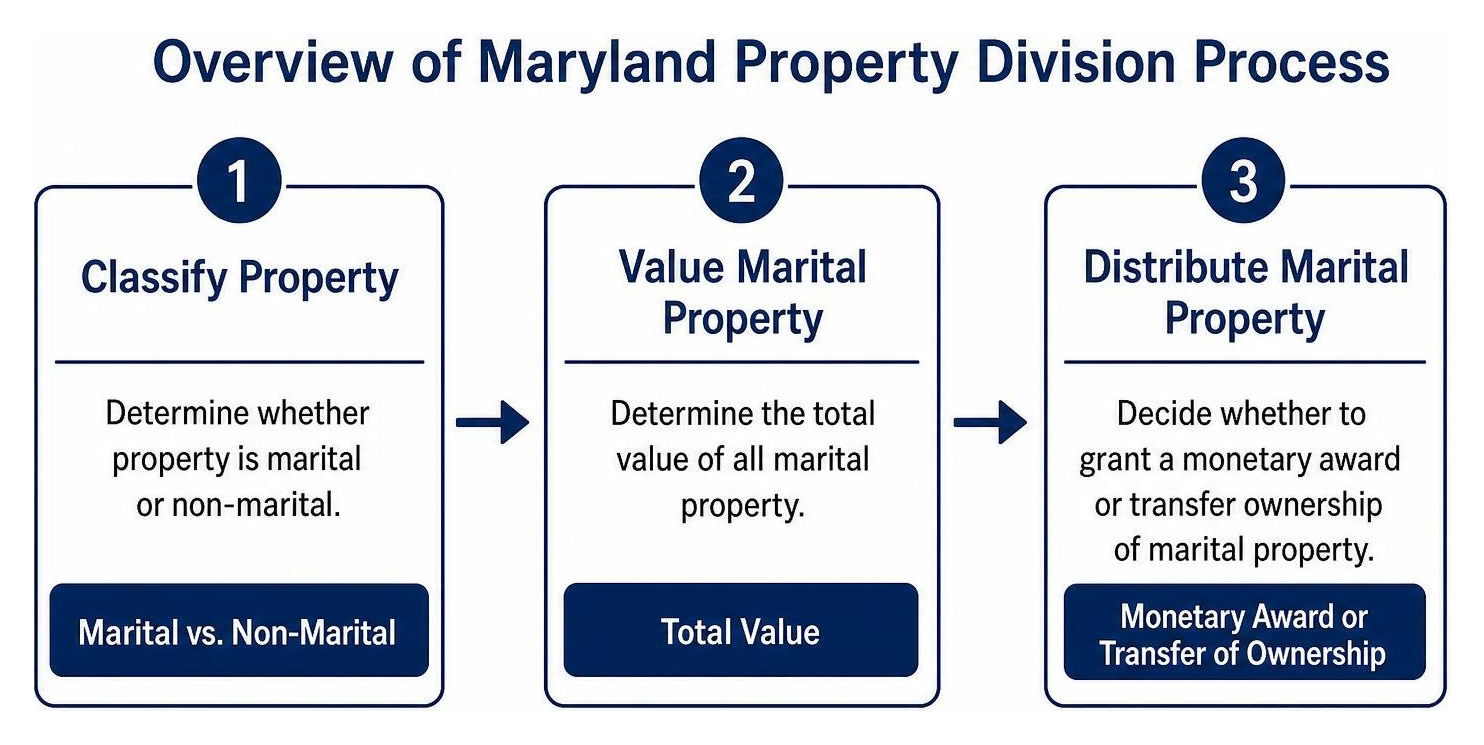
Courts follow a three-step process: classify property as marital or non-marital, determine the total value of all marital property, and decide whether to grant a monetary award or transfer ownership of marital property.
| Property Category | Definition & Scope | Treatment During Divorce |
|---|---|---|
| Marital Property | All real and personal property acquired by either or both spouses during the marriage, regardless of titling. | Subject to equitable distribution and valuation; court may grant a monetary award or transfer title. |
| Non-Marital Property | Property acquired before marriage, assets received by gift or inheritance from a third party, or assets excluded by agreement. | Retained entirely by the individual owning spouse; excluded from direct division. |
| Commingled Property | Non-marital assets mixed with marital assets (e.g., separate inheritance placed in a joint bank account). | May become marital property unless the original owner directly traces the non-marital portion. |
Child Custody, Support, and Parental Rights
Under Maryland FL § 5-203, both parents are established as joint natural guardians of their minor children. Neither parent starts with a legally superior right to custody over the other.
If one parent passes away, abandons the household, or is judicially declared incapable of acting as a parent, the remaining parent becomes the sole natural guardian. Furthermore, under specific circumstances, if unemancipated minor parents have a child receiving temporary cash assistance, the child’s grandparents can be held jointly and severally liable for support obligations to the extent the minor parent lacks financial resources.
Child Custody Factors and Joint Custody
Child custody under Title 9 consists of two distinct legal elements:
- Legal Custody: The authority to make major, long-term decisions regarding a child’s life, including education, healthcare, religious upbringing, and welfare.
- Physical Custody: Where the child resides physically and the day-to-day parenting schedules.
When parents cannot reach a voluntary settlement using the mandatory Maryland Parenting Plan Tool (Form CC-DR-109), courts determine custody using the “best interest of the child” legal standard.
Key factors evaluated by Maryland judges include:
- The stability and health and welfare of the child.
- Frequent contact with parents who can act in the child’s best interest.
- Willingness of parents to share custody and maintain relationship ties.
- The child’s relationship with each parent.
- The child’s physical and emotional security.
- The child’s developmental needs.
- The day-to-day needs of the child.
- How to: place the child’s needs first, protect the child from parental conflict, and maintain the child’s relationship with relatives.
- Age of the child.
- Any military deployment and its effect.
- Any prior court orders and agreements.
- Each parent’s roles and tasks related to the child.
- The location of each parent’s home.
- The parents’ relationship with each other.
- The child’s preference, if age-appropriate.
- Any other factor the court considers appropriate in determining the physical, developmental, and emotional needs of the child.
Child Support Calculation and Enforcement Guidelines
Title 12 of the Maryland Code sets out explicit statutory child support guidelines. In Maryland, parents are jointly responsible for their child’s care, education, and financial maintenance.
Child support calculations are primarily driven by:
- Combined gross monthly income of both parents.
- Number of minor children requiring support.
- Direct costs for health insurance, extraordinary medical care, and work-related childcare costs.
- The physical custody arrangement (overnight stays divided between parents).
If parents share overnight parenting time where each parent keeps the child for at least 35% of the year (128 overnights or more), the court applies a shared physical custody formula, which adjusts financial obligations proportionally. Child support payments are typically collected via court-ordered wage garnishment and income withholding to ensure timely compliance.
Alimony Determinations and Domestic Violence Protections
Alimony in Maryland is designed to provide reasonable financial support based on economic need and ability to pay. Governed by Title 11, spousal support is not automatic or intended as punishment.
Maryland recognizes three primary types of alimony:
- Pendente Lite Alimony: Temporary spousal support awarded while the divorce litigation is ongoing to preserve financial status quo.
- Rehabilitative Alimony: The most common form, awarded for a fixed duration to enable the receiving spouse to obtain education, training, or employment skills necessary to achieve self-support.
- Indefinite Alimony: Awarded without a fixed end date, reserved for situations where a spouse cannot make substantial progress toward self-support due to age or disability, or where the standards of living between spouses will remain unconscionably disparate.
The 12 Statutory Alimony Factors
Courts evaluate 12 distinct statutory factors under Maryland FL § 11-106 when determining the amount and duration of alimony awards:
- Ability to be Self-Supporting: The financial capacity of the party seeking support.
- Time Required for Training: The time and cost needed to acquire education or employment skills.
- Standard of Living: The lifestyle established during the marriage.
- Duration of the Marriage: The length of time the parties were legally married.
- Monetary & Nonmonetary Contributions: Financial earnings and nonmonetary contributions made to the family’s well-being (such as homemaking and childcare).
- Circumstances of Estrangement: The facts leading to the breakdown of the marriage.
- Age of Each Party: Physical health and age considerations.
- Physical and Mental Condition: The health status and limitations of both spouses.
- Agreements Between Parties: Terms set forth in valid marital settlement agreement.
- Financial Needs and Resources: Income, marital property awards, and independent assets of each spouse.
- Financial Obligations: Independent debts and support duties of each spouse.
- Medical Assistance: How an award relates to spouse becoming eligible for medical assistance.
To review a deeper statutory analysis of spousal maintenance guidelines, read our dedicated article on Twelve Factors Alimony Maryland.
Protective Orders and Victims’ Rights
Ensuring safety against domestic violence is a critical priority under Maryland law. Victims of physical abuse, threats, stalking, or harassment can seek immediate legal protections through circuit or district courts using Form CC-DC-DV-001.
Protective orders can order an abuser to cease contact, vacate a shared home, surrender firearms, give temporary custody of minor children, and pay temporary emergency financial support. To ensure safety, petitioner addresses can be shielded from public record via Form CC-DC-DV-026.
Marriage Requirements, Order Modifications, and Name Changes
Maryland law regulates the formal entry into marriage under Title 2, as well as the post-decree modification of established custody, support, or alimony orders.

Marriage Licensing and Age Restrictions
To get legally married in Maryland:
- Age Requirements: Individuals aged 18 and older may marry without restriction. Minors aged 16 or 17 may marry only with written parental consent or proof of pregnancy. Minors under 15 years old are strictly prohibited from marrying under state law.
- License Fees: Base marriage license fee is $10, though local county additions can increase total costs up to $75 (such as in Baltimore City to fund local domestic violence support programs).
- Waiting Period: Maryland law mandates a strict 48-hour waiting period after applying before the marriage license becomes legally effective, unless a circuit judge authorizes an exception for good cause.
Modifying Existing Custody and Support Orders
Family court decrees are not always set in stone. When life circumstances shift significantly, either parent can petition the court for a modification of custody, visitation, or child support orders.
To succeed in a modification petition, the moving party must establish:
- Material Change in Circumstances: Showing a fundamental shift in conditions that directly affects the child’s welfare or a parent’s financial standing (e.g., job loss, relocation, medical changes, or changes in the child’s health or educational needs).
- Best Interests Assessment: Proving that the requested modification aligns with the best interests of the minor child.
In addition to modifying decrees, individuals undergoing major family transitions often seek name changes. To understand the official filing procedure, read our comprehensive guide on how to Legally Change Your Name Maryland.
Self-Help Resources and Interstate Enforcement
Navigating court procedures without private counsel can be overwhelming. Fortunately, Maryland provides self-help legal resources and strict statutory frameworks to manage interstate custody and child support enforcement.
Role of Family Court Help Centers
Maryland operates 24 Family Court Help Centers across its counties, offering free procedural and legal guidance to self-represented litigants. These walk-in centers assist individuals with divorce, custody, child support, name changes, and protective orders.
Crucial operational guidelines for Help Centers include:
- Scope of Service: Staff attorneys and paralegals can assist with form completion, explain court procedures, and guide litigants on answering or filing petitions.
- Representation Limits: Help Center staff cannot represent you in court, file paperwork on your behalf, or offer advice if you already have private legal representation.
To explore local walk-in assistance programs, check details on the Title Frederick County Family Law Clinic | The Maryland … legal aid series. For details regarding protective proceedings for vulnerable adults, read our analysis on Guardianship of an Alleged Disabled Person in Maryland.
Interstate Custody and Out-of-State Support Enforcement
When family members move across state lines, enforcing custody and financial obligations requires standardized interstate laws:
- Uniform Child Custody Jurisdiction and Enforcement Act (UCCJEA – Title 9.5): Dictates which state court has home-state jurisdiction to issue or modify child custody orders, preventing jurisdictional disputes and forum shopping between states.
- Uniform Interstate Family Support Act (UIFSA – Title 10): Governs interstate registration, enforcement, and modification of child support orders, allowing Maryland courts to collect support payments across state boundaries using national wage garnishments and tax offsets.
Frequently Asked Questions About Maryland Family Law
What are the main grounds for absolute divorce in Maryland?
Absolute divorce can be granted based on mutual consent, six-month separation, or irreconcilable differences.
How do Maryland courts calculate child support obligations?
Child support is calculated using statutory guidelines under Title 12 based primarily on both parents’ combined monthly gross income, the number of minor children, physical custody overnight schedules, and direct costs for health insurance and work-related childcare.
Can an out-of-state custody or support order be enforced in Maryland?
Yes. Under Title 9.5 (UCCJEA) for custody and Title 10 (UIFSA) for child support, out-of-state court decrees can be registered and directly enforced in Maryland circuit courts against non-compliant parties living in the state.
Conclusion
Navigating Maryland family law requires a clear understanding of legal rights, procedural court requirements, and financial protections. Whether facing child custody evaluations, spousal alimony determinations, property division, or domestic abuse concerns, having experienced guidance ensures your legal rights and family are thoroughly protected.
At WhitbeckBeglis, our legal team provides steady counsel, skilled negotiation, and aggressive courtroom advocacy tailored to your unique domestic needs. Learn more about our firm’s regional capability by reviewing our announcements regarding the National Family Law Firm WhitbeckBeglis Expanding Rockville Maryland Partner position and the launch of the National Family Law Firm WhitbeckBeglis New Rockville Maryland Office.
For comprehensive assistance across all domestic relations matters, explore our dedicated services covering https://wblaws.com/family-law/ and contact us today to schedule a confidential legal consultation.